
There are pieces that are born out of a specific need and pieces that are born out of an impulse. The palm cap with natural shells that I incorporated into esdeinés this year was born from both at the same time.
I wanted something for the summer that was truly mine. Not an accessory bought anywhere, not something everyone else wears the same. Something that when you put it on at the beach or strolling through a market on a Saturday morning said something. And, incidentally, something that would protect from the sun without sacrificing an ounce of personality.
The base is woven by artisans specializing in palm, a material with a rich history in Spain that requires real craftsmanship to work with properly. On that base, I personally add the natural shells sewn by hand and the esdeinés tag that closes each piece. It's a collaboration between different artisan hands, and I think that shows in the result.
The Bucket Hat: The Summer 2026 Trend That's Stronger Than Ever
The bucket hat — or casquete, as they call it in fashion headlines — has been appearing and disappearing from trends for years. But in 2026 something has changed: it's no longer just a nostalgic '90s item or a festival accessory. It has become a summer staple with its own identity, and the most interesting thing is that the handmade version is the most sought after.
The spring-summer 2026 runways made it very clear: natural materials, organic textures, and accessories with character are the protagonists this season. Raffia, palm, esparto, wicker. Everything that smells of craftsmanship, of working hands, of pieces not mass-produced.
And within that trend, the palm bucket hat fits perfectly. It combines the practical — it really protects you from the sun — with the aesthetic, and with the emotional: when it's made with natural materials and has a personalized finish, it tells a story that no industrial hat can tell.
There's also something very powerful this summer around marine motifs. Shells are back in full force, not as kitsch ornaments but as noble material, as a nod to the Mediterranean and nature in its purest state. And I, without having fully planned it, had exactly that in my hands.
Palm: A Material With Craftsmanship Behind It
When I talk about palm, I'm not talking about just any material. Palm has character. It's resistant yet flexible, has a very recognizable visual texture, and above all, it's a material that in Spain has been in the hands of artisans for centuries. There is a whole tradition of working with palm that deserves to be celebrated.
Working with it is not easy. It requires time, patience, and a technique that only comes from years of practice. The artisans I collaborate with master that process: each palm strip is woven with precision, building a structure that is both light and firm, that withstands the sun and wind without losing its shape.
But additionally, palm has something no synthetic material can imitate: natural variation. Each piece comes out slightly different because the material itself is different. This means that no two bucket hats are exactly alike even if they come from the same process. And on that already distinct base, I add the shells: the result, each bucket hat is a completely unique piece.
Natural Shells: Why They Are Different and Why It Matters
The shells I use are natural, and that has a direct consequence: no two are exactly alike. They vary in size, shape, color nuances, and the small reliefs on their surface. Nature doesn't mass-produce, and that shows when you hold them in your hand.
They all belong to the same family of shells. This means that while each one is distinct, they share a visual language. They have the same origin, the same basic structure, the same general color palette. They are different from each other, but recognizable as part of the same universe.
I sew each shell by hand, one by one. Depending on its size and shape, and how it sits on the palm in that particular piece, I decide how to anchor it. It's not a quick process, but it guarantees that each shell is well secured and that the whole makes sense.
No Two Are Alike: What That Really Means
When I say no two bucket hats are alike, I don't say it as an advertising gimmick. I say it because it's literally impossible for them to be.
The palm varies. The shells vary, even within the same family. And my way of sewing them, although it aims for a similar intention in each piece, cannot be exactly replicated. The artisan process has that magic: you can't control the result down to the millimeter, and precisely because of that, the result always has something surprising.
When I deliver a bucket hat, I deliver something unrepeatable. And whoever wears it, wears something that doesn't exist anywhere else in the world. That, at a time when everything is reproduced in millions of identical copies, has a value that goes beyond the price.
The esdeinés Label: The Signature That Closes It All
Each bucket hat has the esdeinés label sewn into it. For me, that's no minor detail: it's the signature. It's the moment a piece stops being a work in progress and becomes something with identity, something that already has a name and will soon have an owner.
Signing what you do is an act of responsibility. I'm saying that behind this there is a story, a process, hands — those of the palm artisans and mine. In a market saturated with anonymous, mass-produced items, putting a name on what you create is almost an act of resistance.
How to Wear the Palm Bucket Hat This Summer
One of the things I like most about this bucket hat is its versatility. It works equally well at the beach or in a village market, for an afternoon on a terrace or a walk in the countryside. Palm has that ability: it elevates any look effortlessly.
With a white linen dress and flat sandals, it's perfect. Also with a swimsuit and a sarong on the shore, or with jeans and a basic t-shirt in the city. It doesn't need to be combined in any special way because it's already the focal point of the look.
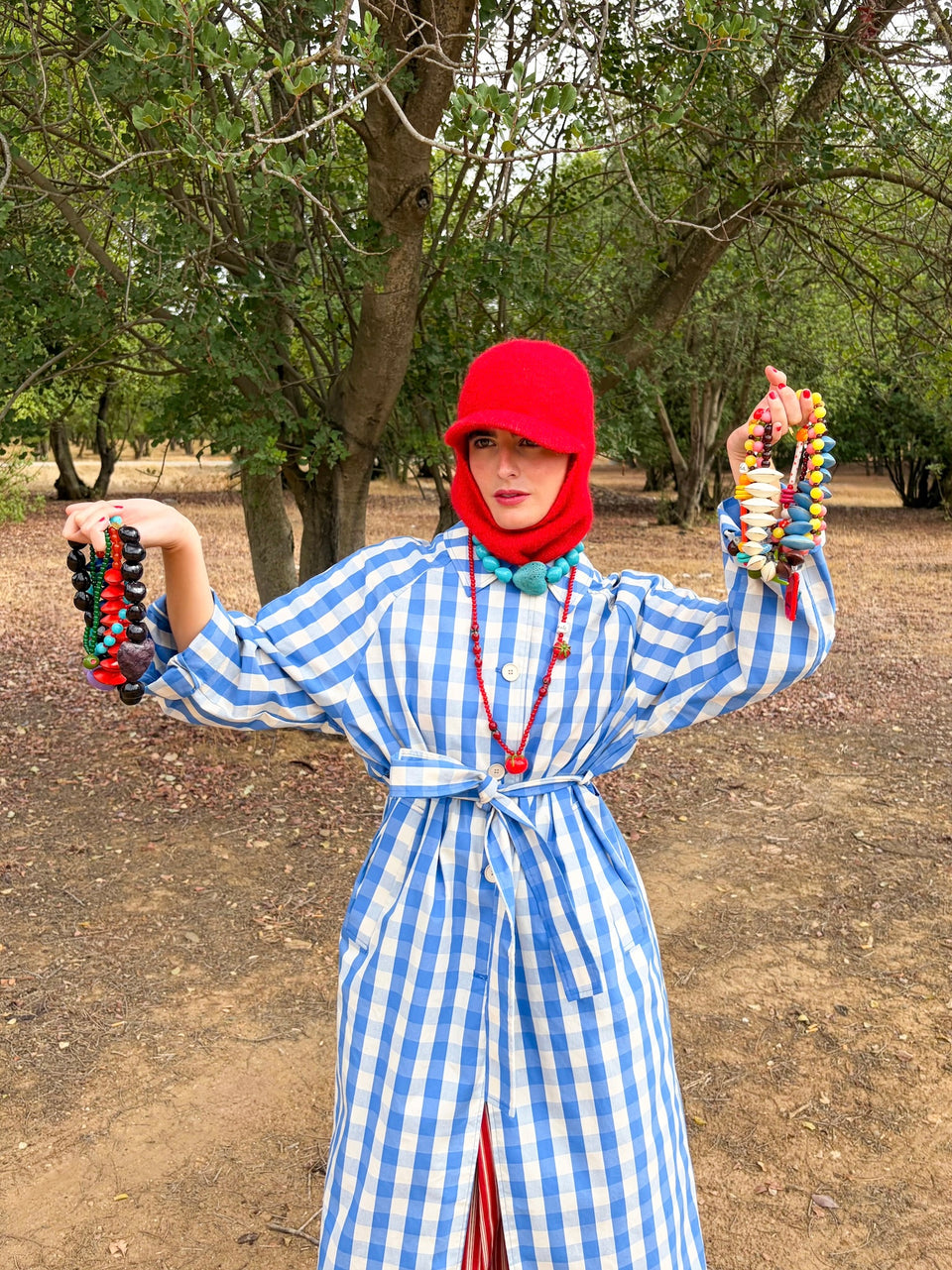
If you want to complete the look with a necklace that speaks the same language, the pieces from the esdeinés summer collection are the natural complement. The Spiral Shell Necklace — made with natural spiral shells, chalcedony, and amethyst — shares the marine language of the bucket hat. The Long Spiral Shell Necklace is the longer version of the same necklace for those who prefer a longer drop. And the Hawaii Necklace, with its thread and resin flowers and yellow shells, adds color to the ensemble without anything clashing.
For hotter days, the Starfish Necklace — natural starfish framed in red macramé — is the most striking option. Or the Big Shell Necklace for a more subdued look, with the natural white shell as the sole protagonist.
The shells add a soft glow when the sun hits them, that sparkle that natural objects have when light touches them just right. It's one of those details that can't be perfectly photographed: you have to see them in person.
If You Want Yours, Don't Wait Too Long
I make these bucket hats in very small quantities. Not because I want to create artificial urgency, but because the process doesn't allow for more: the handmade palm base, the shells sewn one by one, the finish, the label. It's not something that can be sped up without losing what makes it special.
When they're gone, they're gone. And each new batch is different from the last because the materials change and the result changes with them.
If you want to see the palm bucket hat with natural shells, you can find it here: palm shell bucket hat — esdeinés.
If you have any questions or want to see it live, write to me. I always reply.
You can also explore the new arrivals or see all available pieces in the esdeinés store.
This summer, I want you to wear something that is truly yours. Something made with natural materials, by hands that know what they're doing, something that doesn't exist anywhere else. That's what I try to do at esdeinés, piece by piece.
With love,
Inés
esdeines.com